Here's a number that should make every SNF administrator pause:
Not PointClickCare. Not MatrixCare. Not WellSky. Not Netsmart. Nobody.
This isn't a niche oversight. It's a structural gap in how post-acute care software is built — and it's costing facilities time, money, and clinical accuracy every single day.
What the Incumbents Actually Offer (Spoiler: Nothing)
Let's look at what the four largest post-acute EHR platforms provide for oncology workflows, based on their publicly documented feature sets as of mid-2026:
| Oncology Feature | PointClickCare | MatrixCare | WellSky | Netsmart |
|---|---|---|---|---|
| Chemotherapy order management | ✗ | ✗ | ✗ | ✗ |
| Tumor registry (CoC/NCDB) | ✗ | ✗ | ✗ | ✗ |
| Clinical trial matching | ✗ | ✗ | ✗ | ✗ |
| Survivorship care plans | ✗ | ✗ | ✗ | ✗ |
| Oncology-specific lab panels | ✗ | ✗ | ✗ | ✗ |
| Radiation oncology tracking | ✗ | ✗ | ✗ | ✗ |
That's not a comparison — it's a vacuum. And it's not because oncology isn't relevant to post-acute care. It's because the incumbents were built in the 2000s around Medicare Part A reimbursement workflows, and cancer care doesn't fit neatly into that box.
Why This Gap Exists
1. Legacy Architecture
PointClickCare runs on Java Server Faces — a framework from 2004. MatrixCare and WellSky carry decades of acquired codebases stitched together through M&A. Adding a new clinical domain like oncology isn't a feature sprint; it's an architectural overhaul that threatens existing revenue streams. When you have 27,000+ provider sites on your platform, you don't touch the foundation.
2. Reimbursement Blinders
Post-acute EHRs were built to optimize Medicare FFS billing: MDS assessments, PDPM classification, therapy minutes. Oncology straddles multiple payment models — Medicare Part B for physician-administered drugs, Part D for oral chemotherapy, commercial prior auth for radiation. It's administratively complex, and the incumbents stayed in their lane.
3. The "Good Enough" Trap
Most SNFs handle oncology through workarounds: a separate oncology EMR (like Flatiron or OncoEMR) alongside their primary post-acute EHR, or — more commonly — paper chemo flow sheets and Excel spreadsheets for tumor board tracking. It "works" in the sense that patients get treated. But the fragmentation is brutal: duplicate data entry, missed drug interactions, no reconciliation between the oncologist's treatment plan and the SNF's medication administration record.
What a Built-In Oncology Module Actually Looks Like
Here's what the market needs — and what a modern unified platform can deliver by having oncology as a first-class clinical domain rather than an afterthought:
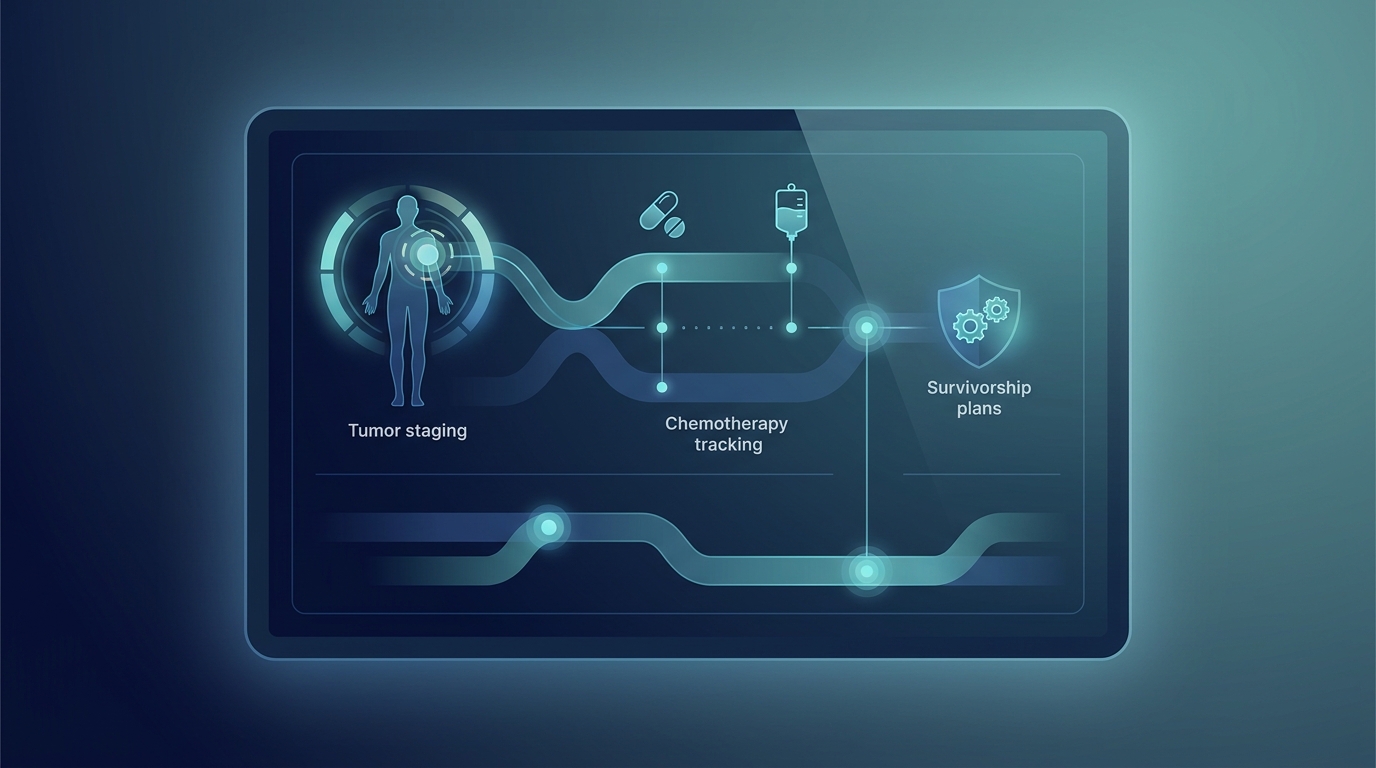
Chemotherapy Order Management
Protocol-driven order sets with weight-based dosing calculations, cycle tracking, pre-medication workflows, and real-time interaction checking against the patient's full medication list — inside the same system that runs their eMAR. No more transcribing chemo orders from the oncologist's portal into the SNF's MAR by hand.
Tumor Registry Integration
Automated abstraction of Commission on Cancer (CoC) and NCDB-required data elements directly from the clinical record. Stage, histology, biomarkers, treatment timeline — populated from structured data rather than manual chart review. Your facility goes from spending 6-8 hours per case on registry abstraction to near-zero.
Clinical Trial Matching
For the 3-5% of cancer patients eligible for clinical trials, having trial matching built into the EHR — with demographic, diagnosis, and biomarker filtering against ClinicalTrials.gov — closes a gap that most SNFs don't even know they have. Patients get access to therapies they'd otherwise miss.
Survivorship Care Plans
ASCO-compliant survivorship care plans generated from the treatment record, with automated follow-up scheduling, late-effect monitoring, and coordination back to the referring oncologist. This is a CMS quality metric that most SNFs fail because they lack the tooling.
Why This Matters Now
Three tailwinds are converging:
- Aging demographics. The 65+ population will hit 80 million by 2040. Cancer incidence increases with age. More cancer patients = more post-acute oncology care. The SNFs that build this capability now capture the demographic wave.
- CMS value-based purchasing. Oncology care quality measures — timely chemotherapy administration, survivorship plan completion, pain management — are increasingly tied to reimbursement. Facilities that can document oncology quality in-house outperform on these metrics.
- Oncology medical home models. CMS's Oncology Care Model and successor programs reward coordinated, multi-setting cancer care. SNFs that participate need EHRs that speak the oncology language — LOINC oncology codes, chemotherapy regimen taxonomies, RECIST response criteria. Generic post-acute EHRs don't.
The Competitive Landscape: Who's Closest?
Flatiron Health (acquired by Roche) dominates oncology-specific EHR, but it's built for outpatient oncology practices — it doesn't do MDS, PDPM, or post-acute workflows. Epic's Beacon module handles oncology well, but Epic is hospital-centric and rarely deployed in standalone SNFs. The gap between "oncology EHR" and "post-acute EHR" is currently filled by... nothing. Spreadsheets and fax machines.
This is precisely where a platform built from the ground up with both domains — oncology as a first-class module alongside MDS, eMAR, PDPM, and telehealth — has an asymmetric advantage. It's not bolting cancer care onto a nursing home chart. It's designing the system so that the clinical workflow for a post-chemotherapy patient is as native as the workflow for a post-hip-replacement patient.
The Bottom Line
The post-acute EHR market is mature in many ways — MDS submission, medication management, therapy tracking. But oncology is the blind spot that none of the incumbents have addressed. For facilities serving cancer patients (which is all of them, given the demographics), this isn't a feature gap — it's a clinical risk.
A unified platform with built-in chemotherapy orders, tumor registry, clinical trial matching, and survivorship care planning doesn't just reduce admin work. It makes cancer care safer, faster, and more compliant — all inside the same system your nurses and MDS coordinators already use.
That's not a feature. That's the future of post-acute care.